 =
1/2(|F+| + |F-|) and
ΔF = (|F+| - |F-|).
=
1/2(|F+| + |F-|) and
ΔF = (|F+| - |F-|).
One problem with the estimates for |FA| which come directly from the
Karle/ Hendrickson equations is that the values are not always
reasonable; e.g. sometimes the estimate for |FA| is greater than the
total scattering power of the atoms involved.
Terwilliger (1994)
suggests correcting this by using a Bayesian estimate for |FA|
predicated on the prior expected distribution of values:
P(FA) is proportional to
exp(-FA2 / Σ2),
where Σ2
is the expected mean square value of FA within a given
resolution shell, given whatever we know about B values, scattering factors,
etc.
Furthermore we can also use prior knowledge about the likely errors in our
data to condition the probability of the observed quantities
=
1/2(|F+| + |F-|) and
ΔF = (|F+| - |F-|).
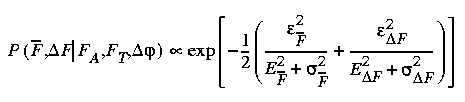
where
and ΔF
After a bit more of this sort of analysis we arrive at the Bayesian estimate for any quantity <x> that depends on FA, FT, and Δφ:
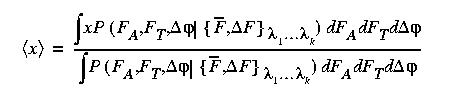
The integration should properly run over all three variables FA, FT, Δφ, but Terwilliger suggests taking FT as being purely defined by its most probable value in order to save computational time.
 back to index
 next topic