 "Lunar Landers" - A model of the heat-labile enterotoxin (LT) from
E. coli attacking a gut cell. The two lunar lander modules
are each a single hexameric protein assembly as seen in the crystal
structure of the LT AB5 holotoxin. The lunar surface is the outer membrane
of an intestinal epithelial cell. Just visible protruding
from the membrane surface under the toxin which has landed are five
copies of the saccharide moitie of ganglioside GM1, to which the toxin
binds. GM1 is a normal membrane component which the toxin coopts as a receptor.
"Lunar Landers" - A model of the heat-labile enterotoxin (LT) from
E. coli attacking a gut cell. The two lunar lander modules
are each a single hexameric protein assembly as seen in the crystal
structure of the LT AB5 holotoxin. The lunar surface is the outer membrane
of an intestinal epithelial cell. Just visible protruding
from the membrane surface under the toxin which has landed are five
copies of the saccharide moitie of ganglioside GM1, to which the toxin
binds. GM1 is a normal membrane component which the toxin coopts as a receptor.
 We have structures for a number mutant toxins containing various single site
mutantations near the active site of the heat-labile enterotoxin.
The Arg7Lys substitution
[1995f]
leads to substantial
destabilization of the loop comprised of residues 47-56, a possible indication
of conformational changes which occur during substrate binding.
The Val97Lys substitution
[1995b]
destroys catalytic activity but does not induce a significant
conformational change at the active site. The larger Lys sidechain occupies an
interior cavity, displacing several water molecules seen in the wildtype toxin.
The Lysine sidechain also forms a salt bridge to the catalytic residue Glu 112.
The structure of a partially activated form of the heat-labile
enterotoxin, in which the A1 and A2 domains of the catalytic subunit are
separated by proteolytic cleavage but remain linked by a disulfide bond, showed
very little change from the fully intact holotoxin
[1994c].
This strongly hints that reduction of the disulfide bond is a crucial step
in activation of the toxin.
We have structures for a number mutant toxins containing various single site
mutantations near the active site of the heat-labile enterotoxin.
The Arg7Lys substitution
[1995f]
leads to substantial
destabilization of the loop comprised of residues 47-56, a possible indication
of conformational changes which occur during substrate binding.
The Val97Lys substitution
[1995b]
destroys catalytic activity but does not induce a significant
conformational change at the active site. The larger Lys sidechain occupies an
interior cavity, displacing several water molecules seen in the wildtype toxin.
The Lysine sidechain also forms a salt bridge to the catalytic residue Glu 112.
The structure of a partially activated form of the heat-labile
enterotoxin, in which the A1 and A2 domains of the catalytic subunit are
separated by proteolytic cleavage but remain linked by a disulfide bond, showed
very little change from the fully intact holotoxin
[1994c].
This strongly hints that reduction of the disulfide bond is a crucial step
in activation of the toxin.
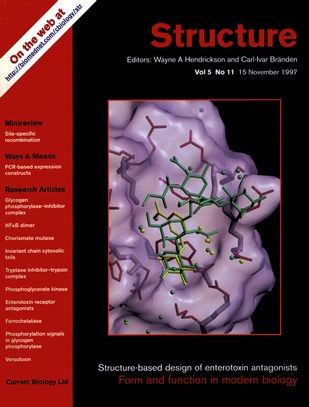
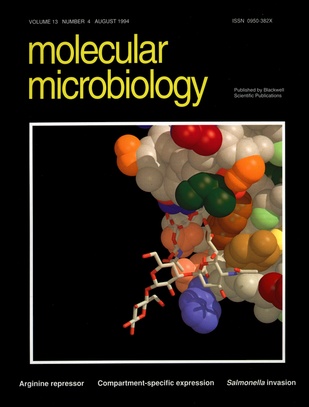 The receptor for cholera toxin and heat-labile enterotoxin is
ganglioside GM1. The toxin recognizes the branched pentasaccharide
portion of GM1 which protrudes from the exterior membrane surface. The
structure of the cholera toxin B-pentamer complexed with the complete
GM1 pentasaccharide
[1994a, 1997d, 1998d]
gives us a view of the
toxin:receptor binding mode at atomic resolution. It provides both a
better understanding of the attachment of the toxin to the cell (see
figure at top of page) and a starting point for the structure-based
design of receptor binding inhibitors. We have futher explored the
stereochemistry of the receptor binding site via complexes of the heat-labile
enterotoxin with smaller fragments of the receptor.
These studies provide a starting point for iterative structure-based
design of potential drugs which block receptor binding
[1995e, 1997d].
The receptor for cholera toxin and heat-labile enterotoxin is
ganglioside GM1. The toxin recognizes the branched pentasaccharide
portion of GM1 which protrudes from the exterior membrane surface. The
structure of the cholera toxin B-pentamer complexed with the complete
GM1 pentasaccharide
[1994a, 1997d, 1998d]
gives us a view of the
toxin:receptor binding mode at atomic resolution. It provides both a
better understanding of the attachment of the toxin to the cell (see
figure at top of page) and a starting point for the structure-based
design of receptor binding inhibitors. We have futher explored the
stereochemistry of the receptor binding site via complexes of the heat-labile
enterotoxin with smaller fragments of the receptor.
These studies provide a starting point for iterative structure-based
design of potential drugs which block receptor binding
[1995e, 1997d].
 We have used structure-guided synthesis
[1999c]
and combinatorial chemistry
[1999d]
starting from galactose to find derived compounds that bind
to the toxin with an affinity gain of several orders of magnitude relative to galactose itself.
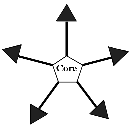
A further dramatic increase in receptor-blocking power comes from linking five of these
small compounds together to form a "pentapus" whose 5-fold symmetry matches that of
the toxin B-pentamer
[2000a].
Additional combinatorial, synthetic and structural work followed.
We have used structure-guided synthesis
[1999c]
and combinatorial chemistry
[1999d]
starting from galactose to find derived compounds that bind
to the toxin with an affinity gain of several orders of magnitude relative to galactose itself.
A further dramatic increase in receptor-blocking power comes from linking five of these
small compounds together to form a "pentapus" whose 5-fold symmetry matches that of
the toxin B-pentamer
[2000a].
Additional combinatorial, synthetic and structural work followed.
This work was supported by the NIH (AI34501, AI44954, GM54618) and the University of Washington Royalty Research Fund