Evans and Sutherland Picture System 330 (late 1980s)
These are screen shots taken with a 35mm camera from the
two screens of an Evans and Sutherland Picture System 330/340
in 1988 or 1989. The Picture System and the VAX 780 that
controlled it were both in the laboratory of Lyle Jensen at the
University of Washington.
Lyle had just retired at the time I arrived in Seattle, but
still had an active research program.
Vector graphics (PS330)
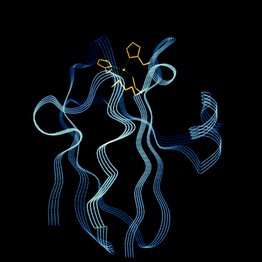 The PS330 was a vector display driven from a host computer,
in this case a VAX 780. The vector ribbon representation
shown here was created by Phil Evans' ribbon module in the CCP
version of Frodo. Frodo ran on the VAX; it downloaded a
list of vectors to the PS330, which allowed you to rotate,
zoom, and pick atoms or menu options via a data tablet (no mouse!).
The hardware was remarkably reliable given that
the VAX was in the next building over; the two halves of
the system were connected by wires that ran into the ceiling
of the computer room, down the hall, up an elevator shaft,
and then along the corridor wall to the lab.
The PS330 was a vector display driven from a host computer,
in this case a VAX 780. The vector ribbon representation
shown here was created by Phil Evans' ribbon module in the CCP
version of Frodo. Frodo ran on the VAX; it downloaded a
list of vectors to the PS330, which allowed you to rotate,
zoom, and pick atoms or menu options via a data tablet (no mouse!).
The hardware was remarkably reliable given that
the VAX was in the next building over; the two halves of
the system were connected by wires that ran into the ceiling
of the computer room, down the hall, up an elevator shaft,
and then along the corridor wall to the lab.
Images scanned March 2002
Raster graphics (PS340)
 |
The early days of Raster3D
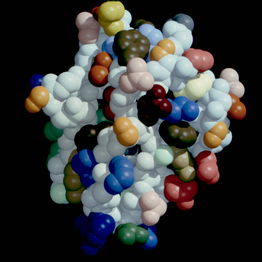
The PS340 was an add-on frame buffer that allowed the
display of raster images downloaded from the host computer.
Its total resolution was about that of a VGA monitor.
In 1988/1989 I ported David Bacon's original Raster3D code
to run on the VAX 780, and wrote a driver program to display
the output on the PS340. This allowed you to compose a
figure in CCP Frodo and then render the same view in Raster3D,
as shown in this pair of images. This may have been
the first setup that allowed composition and rendering of
photorealistic molecular graphics images from an interactive
model-building session. However, there were still some command line
steps required in order to transfer the orientation matrix
from Frodo to Raster3D.
|
Raster displays, pioneered by Silicon Graphics, largely supplanted
calligraphic (vector) displays in the late 1980s.
David Bacon, Mark Israel and Stephen Samuel ported the original
Raster3D to an SGI Iris 3000 workstation at about this same time.
In Seattle the PS330/340 was followed by a PS390 - a purely raster
machine, though still driven from the VAX 780 - and then a series
of SGI and DEC raster graphics workstations.
Ethan A Merritt - April 2002